How Landscapes Shape the People

Mountains as Ancestors, Guardians, and Family
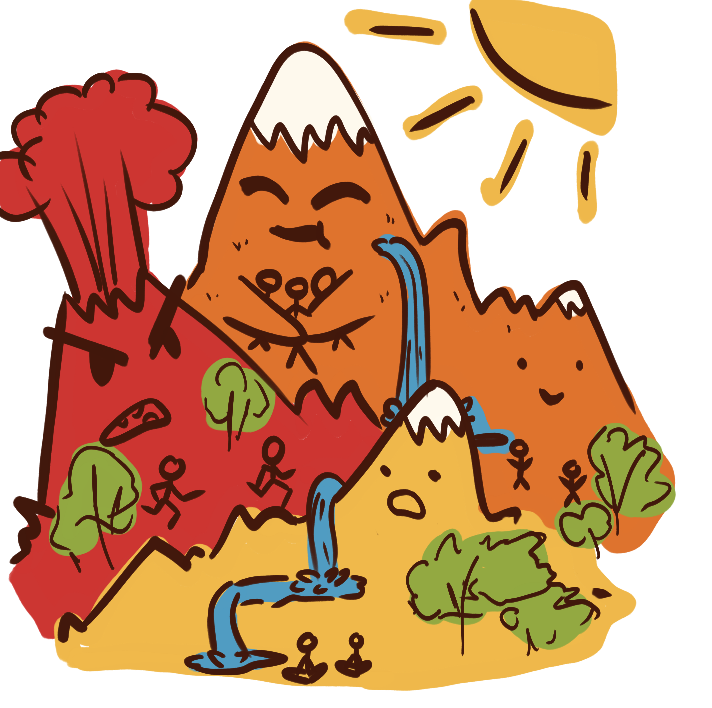
In the Andes, mountains are understood as apus—living beings that watch over the communities around them. The term, rooted in Quechua, translates roughly to “lord” or “powerful being,” reflecting the belief that each peak has agency, personality, and responsibility for the land and people within its domain.
These mountain beings are not abstract deities—they are embedded in local geography and social life. Many are understood as protectors who regulate rainfall, agricultural fertility, and environmental stability. At the same time, they can be unpredictable or punitive, expressing displeasure through storms, landslides, or volcanic eruption. This duality reflects lived experience in high mountain environments, where survival depends on forces that are both sustaining and potentially destructive.
In Ecuador, this relationship often takes on a familial structure. Chimborazo is widely known as Taita Chimborazo (“Father Chimborazo”), while nearby Tungurahua is understood as Mama Tungurahua. Other peaks may be seen as children or companions, forming narrative relationships that mirror human kinship systems. These stories are not merely symbolic—they offer a way of understanding volcanic activity, weather patterns, and the interconnectedness of landscapes through social terms.
Offerings and rituals maintain these relationships. Food, chicha, coca leaves, or flowers are given to the mountains in acts of reciprocity, reinforcing the idea that humans live within a network of obligations to the land. In this way, Andean legend functions as environmental knowledge: it teaches that mountains are not passive terrain, but active participants in shaping life.
Water, Rainbows, and Movement Between Worlds
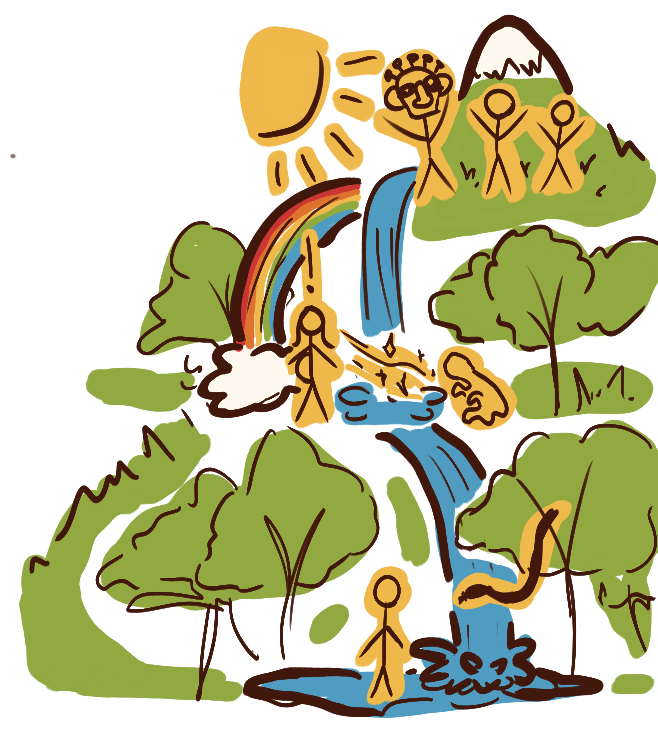
On the eastern slopes of the Andes, constant moisture generates dense networks of rivers and waterfalls. These features are not only ecological systems—they are understood as points of connection between worlds. Flowing water, mist, and spray create environments where transformation is visible, and where spiritual presence is often felt most strongly.
Highland festivals such as Inti Raymi reflect this same relationship between environment, cycles, and belief. Celebrated around the June solstice, Inti Raymi marks the movement of the sun and the renewal of seasonal rhythms tied to agriculture and mountain climates. Central to many Ecuadorian highland celebrations is the figure of the Aya Uma, a masked dancer wearing a two-faced mask and horned headdress. The dual faces represent opposing but complementary forces—day and night, dry and wet seasons, life and death—mirroring the cyclical patterns observed in mountain environments.
Rainbows emerge frequently in these environments, where sunlight meets mist rising from rivers and falls. In Otavalo traditions, the spirit Chuizig is associated with rainbows and with “el mal de arco”—a condition in which a young woman may become mysteriously pregnant after passing beneath one. Like other rainbow beliefs across the Andes, this reflects an understanding of rainbows as active forces rather than passive phenomena—agents of transformation, fertility, and boundary-crossing between worlds.
Among Shuar communities, waterfalls are places to encounter Arútam, a vision-granting spirit associated with strength and protection. These encounters are often sought intentionally, reflecting a belief that knowledge and power can be accessed through engagement with specific landscape features. Water, in this sense, is not just a resource—it is a medium through which relationships with the unseen are formed.