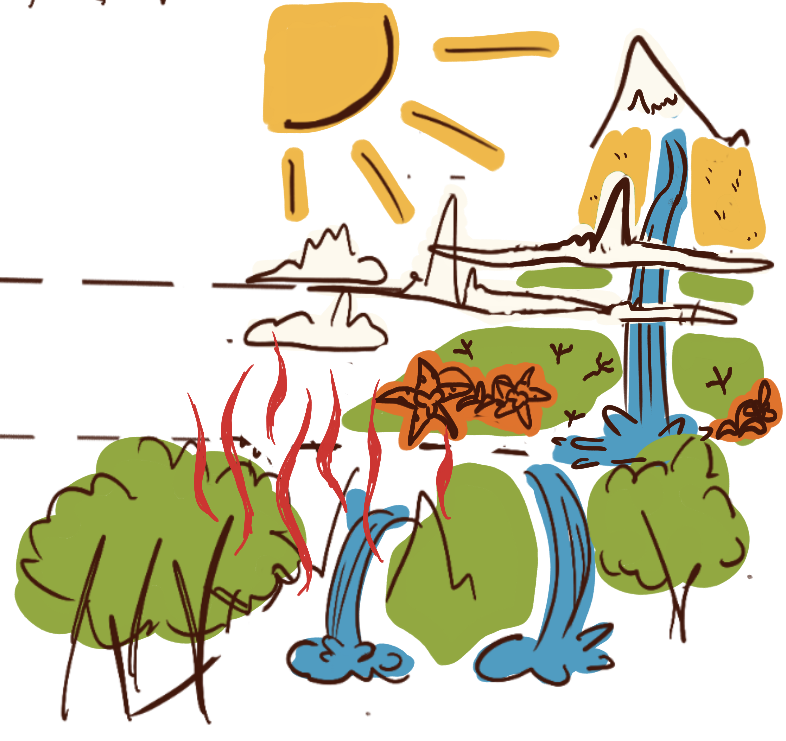
How Mountains Shape Life

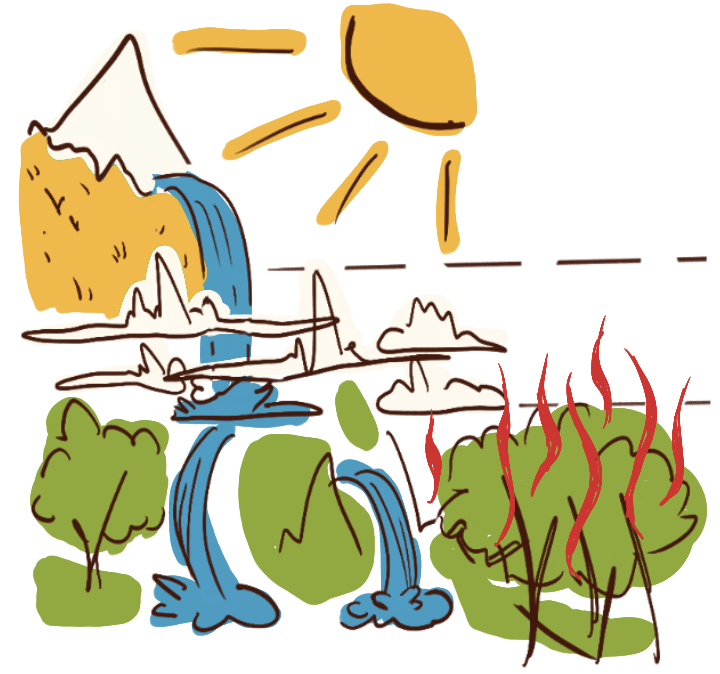
Mountains Shape Living Systems
On the eastern slopes of the Andes, including the valley landscapes around Zuñac Parish, small changes in elevation create entirely different ecological conditions.
Warm, moisture-rich air rises from the Amazon Basin and is forced upward by the mountains—a process known as orographic lift. As the air cools, water vapor condenses into clouds and rain, sustaining the region’s cloud forest environments.
Because temperature drops by about 6.5°C per 1,000 meters of elevation (the environmental lapse rate), ecosystems shift rapidly over short distances. Forest structure, soil moisture, and sunlight exposure all change with slope position, aspect, and elevation.
This creates stacked ecological zones—from lowland rainforest to montane forest and, at higher elevations, alpine grasslands. Each zone supports species adapted to narrow environmental ranges, a pattern known as an elevational gradient.
Mountain ridges and valleys also generate microclimates. Windward slopes receive heavy rainfall, while sheltered areas remain comparatively dry. These variations isolate populations across short distances, contributing to high levels of biodiversity and endemism in the tropical Andes—one of the most species-rich regions on Earth.
Climate Change is Rewiring These Systems
The same conditions that create biodiversity also make Andean ecosystems highly sensitive to change.
As global temperatures rise, species are shifting their ranges upslope to remain within suitable climate conditions—a process known as range shift. But in mountain systems, available habitat decreases with elevation, leading to habitat compression and increased risk of extinction for high-elevation species.
Climate change is also altering the formation of clouds that sustain montane forests. In many tropical mountain regions, the cloud base is rising, reducing the frequency of immersion in moisture that defines cloud forest ecosystems. Even small shifts in cloud cover can disrupt water availability, plant growth, and species interactions.
At the same time, warming temperatures are accelerating glacier retreat across the Andes. Glaciers act as natural water storage systems, releasing meltwater during dry periods. Their loss is increasing variability in water supply, affecting both ecosystems and downstream communities.
Together, these changes are transforming how mountain ecosystems function—altering temperature zones, shifting species distributions, and destabilizing the environmental gradients that sustain biodiversity in places like Zunac.