
How Life and Culture Shape Each Other

Animals as Messengers, Kin, and Material Foundations
In Andean and Amazonian Ecuador, animals are socially and spiritually important—more than just passive wildlife. Their behaviors are observed and interpreted as environmental signals, informing decisions about planting, travel, and ritual timing. This reflects a broader worldview in which humans, animals, and landscapes are interconnected through Pachamama (Mother Earth), forming a living system of reciprocal relationships.
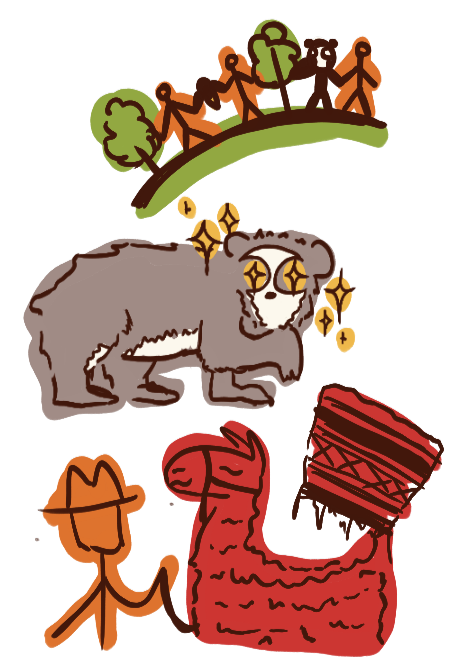
Certain animals take on explicit cultural and mythological roles. In highland Andean traditions, figures like the ukuku—a bear-like being associated with the spectacled bear (Tremarctos ornatus)—appear in festivals and oral histories as intermediaries between humans and mountain spirits. The ukuku inhabits glacier zones and high elevations, symbolically linking human communities to the powerful, unpredictable environments of the upper Andes. These figures reinforce the idea that animals can traverse ecological and spiritual boundaries.
Animals also directly shape material culture. Camelids such as llamas and alpacas provide wool that is central to Andean textile traditions, while birds contribute feathers used in ceremonial dress. The availability and properties of these materials—insulation, color, durability—determine not only how objects are made, but what they signify. Craft traditions are therefore expressions of local biodiversity, embedding animal life into clothing, tools, and ritual objects.
Plants as Food, Medicine, and Tradition
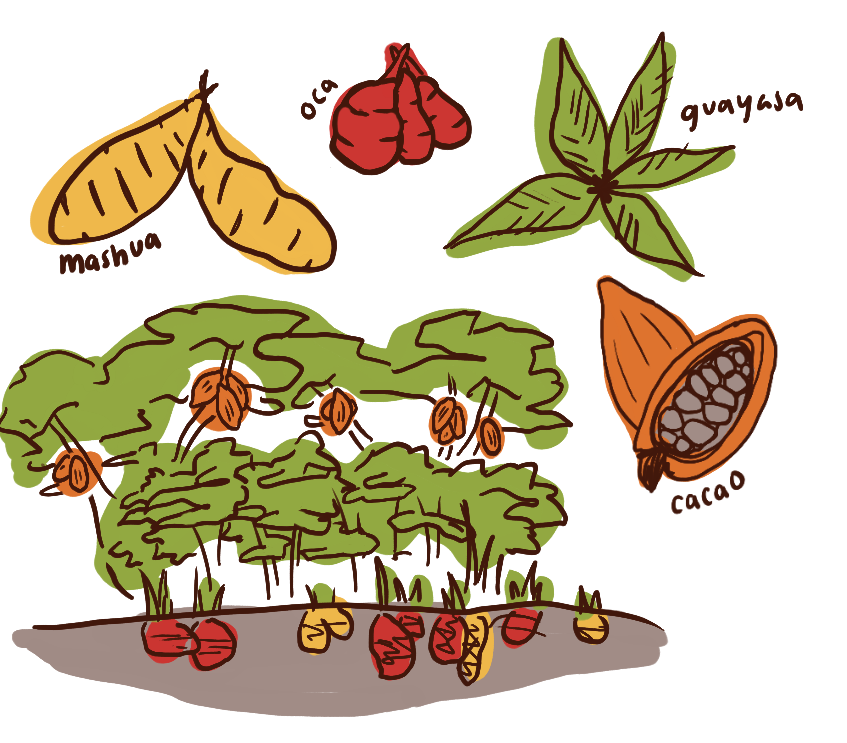
Plant life forms the foundation of subsistence, culture, and belief in the Andean flanks of Ecuador. The region is one of the world’s major centers of domestication, where crops such as maize, potatoes, quinoa, oca, and mashua have been cultivated and diversified over thousands of years across steep elevational gradients. These crops are not only dietary staples—they are culturally significant species tied to identity, ritual, and seasonal cycles.
This relationship is most clearly expressed through the chakra system, an Indigenous agroforestry practice used by Quechuan communities in both the Andes and Amazon. Chakras are highly biodiverse cultivation spaces where dozens of plant species—food crops, medicinal plants, timber, and fibers—are grown together in layered systems that mimic forest structure. Rather than separating agriculture from the natural environment, the chakra integrates them, functioning as a site of food production, knowledge transmission, and spiritual practice.
Specific plants play multiple roles within this system. Cassava, plantain, and maize provide dietary staples, while species like guayusa (Ilex guayusa) are used both as a daily stimulant tea and within social and ritual contexts. Cacao and fruit trees contribute to both subsistence and economic exchange, while a wide range of medicinal plants are cultivated and applied through traditional healing practices.
Agricultural practice itself is guided by cosmology. Planting cycles often align with seasonal and celestial patterns, and cultivation is approached as a relationship rather than a process of control. The chakra is understood as a living system—one that includes soil, water, plants, animals, and people in continuous interaction. In this way, plants shape not only diet and material life, but the structure of knowledge, ritual, and community organization.

